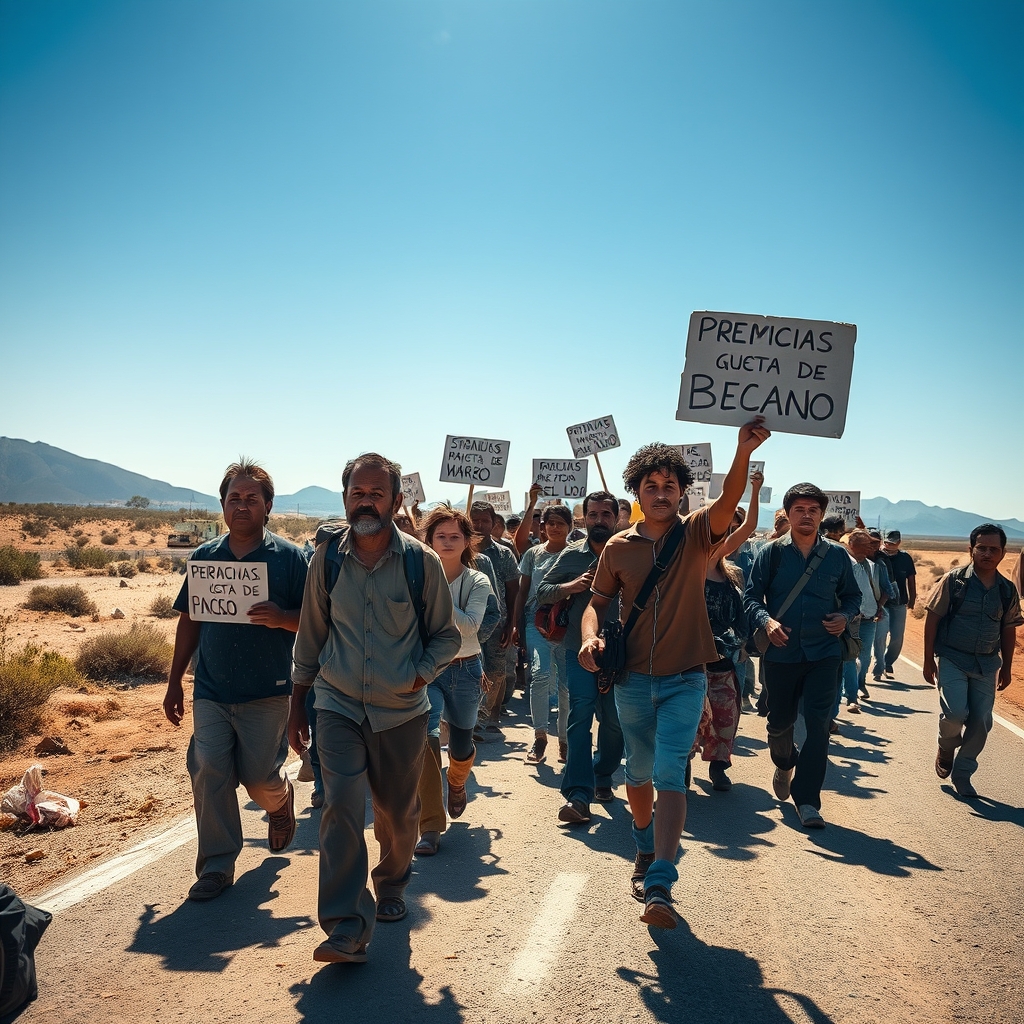
Along the sun-baked highways of southern Mexico, a poignant drama unfolds with every passing day. Under the relentless glare, hundreds of weary souls embark on a journey fraught with peril, their footsteps echoing a collective cry for dignity and safe passage. This isn’t just a trek; it’s a defiant migrant march Mexico has witnessed repeatedly, yet each one carries a unique weight of desperation and hope. Their latest protest, a testament to enduring human spirit, denounces the ever-tightening grip of immigration restrictions, a policy landscape made even more opaque by whispers of clandestine agreements.
These individuals, primarily from Central American nations, are not mere statistics; they are mothers, fathers, children, and siblings, each carrying a story of hardship and a dream of a better life. Their path through Mexico is often the most treacherous leg of an already arduous journey, marked by exploitation, violence, and the constant threat of deportation. The recent march brings into sharp focus not just the visible struggles on the ground but also the unseen machinations of international border policies that profoundly impact their fate.
The Genesis of the March: A Symphony of Desperation
The genesis of this latest wave of collective action lies deep within a confluence of escalating humanitarian crises and increasingly stringent border controls. For many, the decision to leave their homes is not a choice but a stark necessity, driven by gang violence, political instability, and the devastating impacts of climate change that have rendered their livelihoods unsustainable. These are the push factors that compel families to abandon everything they know, seeking refuge and opportunity far from their origins.
Mexico, once primarily a transit country, has found itself increasingly pressured to act as a barrier, a de facto southern border for the United States. This shift has led to a dramatic increase in arrests, detentions, and deportations within Mexican territory, effectively transforming the journey into an even more perilous ordeal. Migrants report being stranded for months in southern states, unable to secure the necessary transit documents, trapped in a bureaucratic limbo that exacerbates their vulnerability.
The restrictions imposed by Mexican authorities, often perceived as a direct result of U.S. pressure, have made legal and safe passage virtually impossible for many. This bottleneck in southern Mexico, particularly in states like Chiapas, creates immense humanitarian challenges, overcrowding shelters and pushing desperate individuals into the hands of criminal organizations. The march, therefore, is not merely a protest; it is a desperate plea for recognition, for humanity, and for the fundamental right to seek asylum.
The collective movement, often organized organically through word-of-mouth and social media, serves as a beacon of solidarity and a strategic attempt to gain visibility and safety in numbers. By moving together, migrants hope to deter criminal elements and draw international attention to their plight, making it harder for authorities to ignore or quietly deport them. It is a powerful, if perilous, strategy born out of profound necessity.
Echoes of Desperation: Voices from the Road
Imagine the dust caking your skin, the sun beating down mercilessly, and the gnawing hunger that accompanies every step. This is the reality for thousands who join these marches, their faces etched with a mixture of exhaustion and unwavering resolve. Among them is Maria, a mother from Honduras, clutching her two young children, their eyes wide with fear and curiosity. She speaks of fleeing threats from gangs that demanded her teenage son join their ranks, a choice between death and a desperate flight.
Her voice, though soft, carries the weight of countless others who share similar harrowing tales. “We only want a chance,” she whispers, her gaze fixed on the distant horizon. “A chance to live without fear, to feed our children, to give them a future.” For her, the march is not just about reaching the U.S. border; it’s about reclaiming a sense of agency, about refusing to be invisible in a system that often treats them as less than human.
Then there’s Mateo, a young man from Guatemala, whose dreams of becoming a mechanic were shattered by a series of devastating droughts that withered his family’s crops. He walks with a limp, a souvenir from a fall during a previous attempt to cross a treacherous river. “I left because there was nothing left for me there,” he explains, gesturing vaguely behind him. “Here, on this road, I find others like me. We share what little we have, our stories, our hopes.”
These personal narratives underscore the profound human cost of restrictive immigration policies. They highlight the resilience of those who, against all odds, continue to push forward, driven by an inherent human desire for safety and self-determination. The voices from the road are a powerful reminder that behind every policy debate and every headline, there are real lives, real struggles, and real dreams at stake.
Unveiling the Shadows: The Alleged Secret Agreement
Adding a layer of intrigue and concern to this already complex situation is the recent suggestion by a U.S. court that a secret deportation agreement might exist between the United States and Mexico. This revelation, if true, would have far-reaching implications for international law, human rights, and the transparency of cross-border governance. Such an agreement, operating outside public scrutiny, could fundamentally undermine the rights of asylum seekers and migrants.
The very notion of a ‘secret’ agreement raises serious questions about accountability and due process. If migrants are being deported under undisclosed terms, it becomes incredibly difficult for them to challenge their removal, access legal counsel, or even understand the basis of their expulsion. This lack of transparency erodes trust in governmental institutions and further marginalizes an already vulnerable population, leaving them without recourse or protection.
For human rights organizations and legal advocates, the existence of such a pact would represent a grave breach of international humanitarian principles. It could mean that individuals seeking asylum, who are legally protected from return to countries where they face persecution, might be summarily deported without a fair hearing. This potential circumvention of established legal frameworks is a deeply troubling prospect that demands immediate investigation and clarification.
The suggestion of a secret deal also speaks to the growing trend of externalizing border control, where wealthier nations lean on neighboring countries to manage migration flows, often at a significant human cost. Such arrangements, whether explicit or implicit, shift the burden of enforcement without necessarily addressing the root causes of migration or providing adequate safeguards for those seeking protection. It underscores a broader pattern of prioritizing deterrence over human dignity.
Mexico’s Shifting Stance: From Transit to Enforcement
Historically, Mexico has often been viewed as a bridge for migrants heading north, a country through which many passed with varying degrees of official scrutiny. However, in recent years, this role has dramatically transformed. Under intense pressure from the United States, Mexico has increasingly adopted a more enforcement-heavy approach to migration, effectively becoming a primary line of defense against irregular migration towards its northern neighbor.
This shift is visible in the increased deployment of Mexico’s National Guard to its southern border and along key migration routes, as well as in the establishment of numerous checkpoints and detention facilities. What was once a relatively fluid, albeit dangerous, journey has become a heavily policed corridor, making passage significantly more difficult and hazardous. The goal, from the perspective of both governments, appears to be deterrence at all costs.
For migrants, this means facing not only the dangers of the journey itself but also the added threat of apprehension and deportation by Mexican authorities. Many report being rounded up and sent back to their home countries or stranded in southern Mexico, unable to move forward or backward. This internal enforcement often pushes migrants into more remote and dangerous routes, increasing their vulnerability to cartels and other criminal groups.
The Mexican government, caught between humanitarian obligations and geopolitical realities, faces a difficult balancing act. While it has expressed a commitment to human rights, the economic and political leverage wielded by the U.S. often dictates its practical immigration policies. This complex dynamic highlights the intricate web of pressures that shape the lives of those navigating the perilous journey through Mexico, turning a humanitarian crisis into a political pawn.
The Human Cost: Impact on Vulnerable Populations
The tightening of immigration restrictions and the potential for secret deportation agreements have a devastating human cost, particularly for the most vulnerable populations. Women and children, often traveling alone or in small family units, face heightened risks of exploitation, sexual violence, and trafficking. The prolonged journeys and lack of safe havens expose them to unspeakable dangers at every turn, transforming their quest for safety into a nightmare.
Children, in particular, bear an immense psychological burden. Witnessing violence, experiencing hunger, and living in constant fear can leave deep and lasting trauma. Many arrive at borders suffering from severe anxiety, depression, and post-traumatic stress, conditions that are often left unaddressed in the chaotic and under-resourced environments of migrant shelters and detention centers. Their childhoods are stolen, replaced by a harsh reality they are ill-equipped to comprehend.
Families are also routinely separated, either by the dangers of the journey, the actions of authorities, or the opaque nature of deportation processes. The anguish of parents losing their children, or children being separated from their guardians, creates profound and often irreparable emotional wounds. These separations not only violate fundamental human rights but also undermine the very fabric of family unity, which is often the last source of strength for migrants.
Furthermore, the lack of access to legal representation and due process under restrictive policies means that many migrants are unable to present their asylum claims effectively. They are often unaware of their rights or unable to articulate their fears in a language they don’t fully command, leading to swift deportations back to the very dangers they sought to escape. This systemic failure to protect the vulnerable perpetuates a cycle of suffering and injustice.
International Ripples: Global Implications of Border Policies
The situation unfolding along Mexico’s southern border is not an isolated incident; it sends ripples across the international community, highlighting broader trends in global migration governance. The increasing tendency for nations to outsource border control and implement restrictive policies has significant implications for international human rights frameworks and the principles of asylum. When powerful nations pressure their neighbors to act as gatekeepers, it often comes at the expense of humanitarian considerations.
Such bilateral arrangements, especially those shrouded in secrecy, challenge the very foundations of international law, which mandates transparency, due process, and the protection of refugees and asylum seekers. They create a precedent where human rights can be sidelined in favor of political expediency, potentially inspiring other nations to adopt similar opaque and restrictive practices. This erosion of established norms is a worrying development for global justice.
International organizations, human rights advocates, and legal experts are increasingly vocal in their condemnation of policies that prioritize deterrence over human dignity. They argue that a sustainable and ethical approach to migration must address the root causes of displacement, create safe and legal pathways, and uphold the fundamental rights of all individuals, regardless of their migratory status. The current approach, they contend, merely shifts the problem, exacerbating human suffering.
The global community has a shared responsibility to ensure that migration is managed in a humane, orderly, and dignified manner. This requires multilateral cooperation, adherence to international conventions, and a commitment to transparency in all agreements pertaining to human movement. The plight of migrants in southern Mexico serves as a stark reminder of the urgent need for a more compassionate and rights-based approach to one of the defining challenges of our time.
The defiant steps of those on the migrant march in Mexico are a powerful testament to the enduring human spirit, a refusal to be silenced or rendered invisible. Their journey, fraught with peril and shadowed by the ambiguities of international agreements, underscores a critical need for greater transparency, accountability, and compassion in global immigration policies. It is a collective call to action for governments to uphold their humanitarian obligations, ensuring that the fundamental rights and dignity of every individual seeking refuge are not merely an afterthought but the guiding principle. The path to a more just and humane world begins with recognizing the inherent worth of every person, offering not just a border, but a hand of solidarity and a promise of a fair hearing.